
The drive in your computer is responsible for the long-term storage for all your files. This includes all your personal files like documents, photos, music, etc, and it also stores all the system files like your operating system and applications.
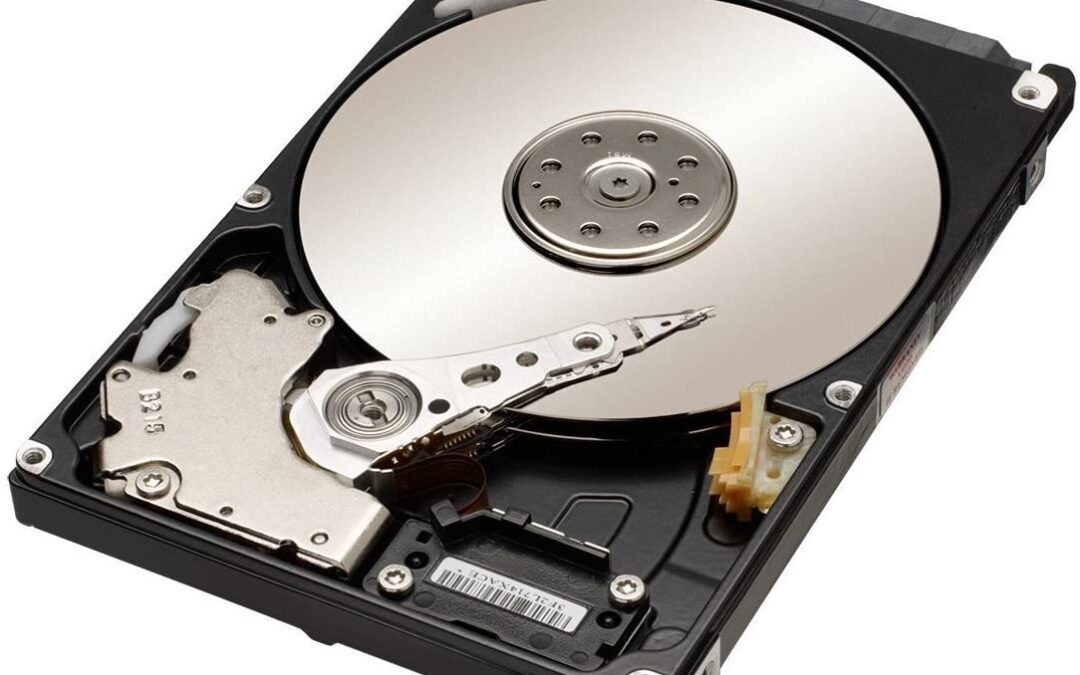
A conventional Hard Disk Drive (HDD) also known as a rotational or spindle disk (or Winchester if you’re old enough) is made of several spinning magnetic disks or platters, which you could think of like a vinyl record but much smaller. There is a tiny head on a motorised arm which moves across the spinning platter to read and write magnetic information.
Although HDDs have improved over the years, they are still based on technology from the 1960s. They use a lot of power to run the motors and arms, generate a lot of heat, and constantly running motors wear out over time and get slower and slower, causing performance issues as they get older. HDDs are also easily damaged by overheating, knocks or damp conditions.
SSDs or Solid State Drives have become more commonplace in new computers; as the name suggests they are totally solid and have no moving parts. These devices use the same technology as USB memory keys, they have no motors or moving arms so the power demands are much lower than HDDs and Solid State Drives do not generate much heat compared to their predecessors. They are also not susceptible to vibration damage.
Because there is no motorised head in an SSD, there is no lag between read operations, so this means they are lightning-quick, about 10 or 15 times the read speeds of conventional drives and this can make a computer feel around 3 or 4 times faster and more responsive than one fitted with a HDD; retrofitting an SSD is a really good way to breathe new life and performance into an aging computer.
Small SSD drives are quite cheap; good quality 120GB drives around £40, 240GB around £75. But in larger capacities they are still quite expensive, around £100 for a 1TB, whereas an equivalent HDD would be half this cost.
I hope you find this information useful. If you would like to see particular subjects covered then please feel free to ask at www.alfindlay.com.